


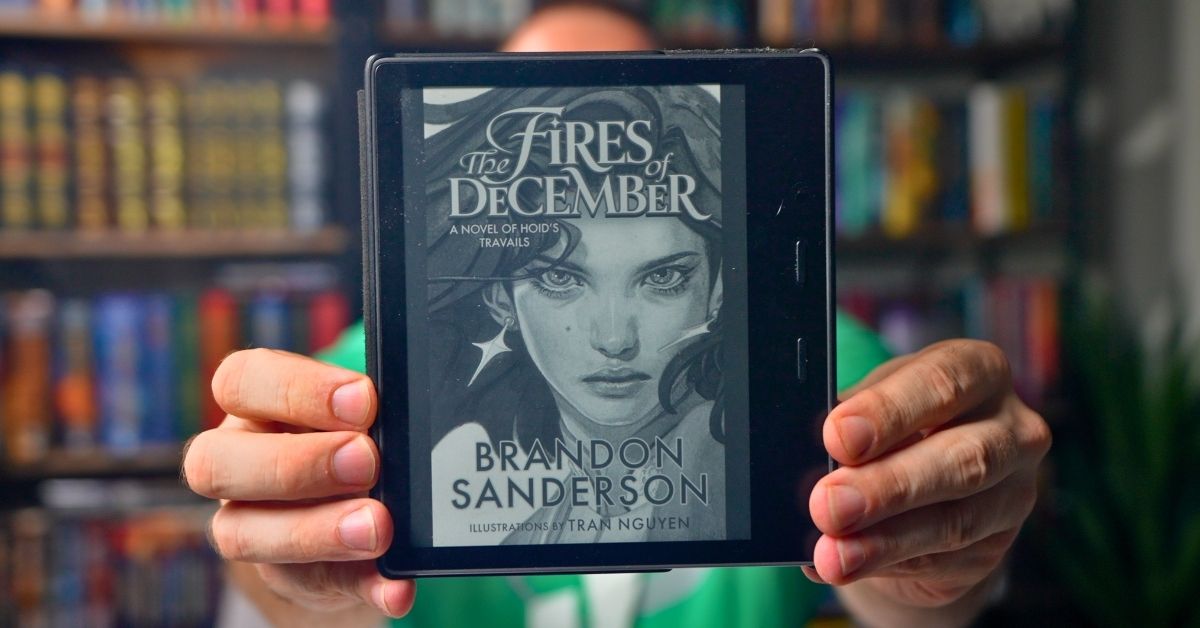
The Fires of December is Brandon Sanderson’s newest Cosmere novel, and it takes us to a world of demons, rivers of blood, and a woman trying to stop a devastating plague. I’ve just finished reading it, and I’m excited to talk about this one.
Backers got the book early, with the full release coming in December, so we’re keeping this review spoiler-free. I’ll mention details from the book’s blurb and the public descriptions you’d find on sites like Amazon, but I won’t spoil anything beyond that. We’ll talk about the world, the characters, and what makes this story different, so you have a good idea of what to expect when you pick it up.
The Fires of December [Video Review]
A world worth entering
The rivers in this world are made of colorful, magical demon blood, and people have built entire communities around them. They travel on these rivers and depend on them to live. I love how something as bizarre as a river of demon blood is just part of everyday life in this world.
Our main character, December, grew up as an orphan in a small town on the riverbank, with other people constantly telling her who she was supposed to be and what she should do with her life.
Then something happens that convinces her a devastating plague is coming, so she sets off to travel up one of these rivers of blood to warn the king. Along the way, she meets some new companions, including a chatty priestess and a fashion designer.
What I like about that setup is that getting to the king is only the first part of the challenge. December is coming from a small town, and now she has to find a way to convince people who have their own plans and very little reason to listen to her. A big part of the story is how she tries to get them to take this danger seriously.
And a big part of why I cared so much about December and wanted to follow her story comes from how Sanderson introduces her in the first chapter.
Why the first chapter works so well
I honestly think the first chapter might be one of the best chapters Sanderson has ever written. It almost works as a short story on its own, with a beginning, a middle, and an end. By the time it’s over, you’ve been introduced to this world, December already has a lot of depth, and the story has thrown several curveballs that changed where I thought it was going.
Brandon gives you time to really understand her. You see how people treat her and how she develops as she grows up. Some of the situations she goes through are terrible, and the choices she has aren’t always good ones. You follow her through a long stretch of her life, so you get to see how those experiences change her and shape the decisions she makes later. That’s a big part of why I became so invested in her.
You’re getting to know the world along with her, too. You learn about the town’s customs, what people believe, and how this small place fits into the wider world. Those things affect how people treat December and how they treat each other. And because the chapter follows them over time, you can see how one person’s decision can go on to affect several other people’s lives.
There’s a lot of sadness in this opening, and parts of it are pretty dark. It also has an almost storybook feel. Hoid is telling the whole book, but this first chapter has a very different tone from much of what follows. I found myself getting lost in December’s story, and it became a real highlight for me.
The writing, the structure, and the emotional side of that chapter all came together for me. I’ve rarely seen a story begin quite like this, and I certainly hadn’t seen Sanderson open a book this way before. Some of the turns really shocked me. By the time I reached chapter two, I was already rethinking what I thought this book was even going to be about.
You sometimes hear people say that Sanderson’s writing is predictable or that his books follow a formula. I don’t really agree with that, and this chapter is a great example of how much variety he can bring to his writing. The way he introduces December and tells this part of her story felt completely different from what I was expecting.
The rest of the novel does change quite a bit in tone, though, so let’s talk about Hoid and how his voice changes the experience as the book goes on.
Hoid and the change in tone
Hoid is telling this story, and once you get past chapter one, you start getting a lot more of his personality. He’s interjecting his thoughts, commenting on the characters, and joking with the reader. The opening has that darker feel, while what follows is much more like the kind of fantasy storytelling you’d expect from Hoid.
I loved the opening, but I’m not sure that exact tone would have worked for the entire book. Sanderson actually talks about this in the postscript. He considered keeping that storybook style, but wanted to bring the reader closer to December and the other characters, so he chose a more familiar voice for the rest of the story.
Hoid gives you a lot of context about the world, throws in his opinions, and works in Cosmere terms and bits of lore along the way. There are some really funny moments, and I generally found him entertaining. If you’ve read something like Tress of the Emerald Sea, you’ll have a good idea of the kind of narrator you’re getting here.
I do think he overdoes it a little when he keeps reminding you not to judge December or the other characters too harshly. He explains that they don’t have the information we have, or that what they’ve been through has shaped the way they see things. Their decisions might seem strange to us, but they make sense to them. And that’s a completely fair point.
The problem is that he makes it over and over. After a while, my reaction was: I get it. Their world is different from mine. They’re not always going to act the way I would, and I don’t need Hoid to keep pointing that out. A lot of the time, the story has already given me enough to understand why they’re acting that way. It just felt a little overdone.
His narration also adds to the more modern feel of this Cosmere story. The language and references aren’t always what you’d expect from traditional fantasy. Hoid even uses a helicopter as a comparison. He’s bringing knowledge from elsewhere in the Cosmere into the way he tells this story, and sometimes those references stand out.
The world itself has that mix, too. Some of its technology is more advanced than what we’ve seen in other Cosmere settings. There’s a king and a court, but that doesn’t mean everything else fits an old-fashioned fantasy setting. The book explains how its world works, and I thought those things fit together.
For me, it works better when that modern feel is established from the beginning. When a series starts feeling much more modern several books in, the change can be jarring. Some readers had that criticism of the language in Wind and Truth. Here, the technology and the way people speak are part of the world from the start, so they made sense to me.
I do think it’s worth knowing about before you pick it up, though. Some people enjoy that mix, while others prefer a more traditional fantasy world that feels further removed from modern life. Knowing that going in should give you a better idea of what to expect from the language and the humor.
December’s perspective
December was one of my favorite things about the book. What happens to her gives her a very unusual way of looking at things, and that affects her decisions throughout the story. It’s a big part of what makes her interesting to follow.
Sanderson carries that experience into all the choices she makes. It affects who she pays attention to, what she notices about them, and what she’s willing to put up with. She grows a lot throughout the book, but I still found her relatable from beginning to end. I could understand why she felt the way she did, even as her circumstances and her understanding of the world changed.
She’s also smart and capable in a way I really enjoy reading about. Sixth of the Dusk is a good comparison for what I mean. I like following a character who pays attention, recognizes a problem, and looks for practical ways to deal with it. December notices what other people need, but she’s also learning what she needs herself and what she has to do to get things done. You get to see her use those qualities and develop them over time, which makes her interesting well beyond the question of whether she can deliver her warning.
Her experience can also lead her to make mistakes and false assumptions about people. She’s tired of everyone putting her in a box, but you can see her doing the same thing to others. I thought those two sides of her fit together really well. We can dislike being judged and still catch ourselves judging somebody else, and the book actually deals with that. December has reasons for thinking the way she does, but those reasons don’t always mean she’s right.
That becomes especially interesting when she travels to see the king and finds herself in a society that’s very different from the one she grew up in. It reminded me of Vivenna arriving in T’Telir in Warbreaker: that feeling of entering a city where the way people live is completely unfamiliar to you. December is a very different character from Vivenna, so her reactions are different, too. But if you enjoyed watching someone try to make sense of an unfamiliar city and its customs in Warbreaker, there’s some of that appeal here as well.
December is also really empathetic, and given what she’s been through, you can understand why. It comes through in who she decides to help, when she gets involved, and who she’s willing to confront. She pays attention to what a person is dealing with and tries to work out what she can do about it. Those choices tell you a lot about her.
By the end, I just wanted to see more of her. This is a complete standalone story, and it would still work if we never saw December again. But I think Sanderson develops so much in her that there’s a lot he could do with her elsewhere in the Cosmere. I’d love to see her become a bigger part of it, because I enjoyed following her enough that I’d happily read more.
Worldbuilding and magic
Worldbuilding and magic systems are what I think Brandon Sanderson does best, and the worldbuilding here was a big part of what I loved about this book. Seeing how this world has developed around demon blood is fascinating, and I wish I could talk more about it without giving anything away. The more you learn about what’s actually going on, the more interesting it gets.
Those colorful rivers of demon blood are such a great image, and I loved seeing how Sanderson worked the magic into that idea. Hearing “demon blood” might make you picture something pretty grim, but he takes it in some really colorful and imaginative directions. The ways people use it and interact with it were very different from what I expected. I haven’t read anything quite like it, in the Cosmere or elsewhere.
I also love how much thought he puts into the everyday details of these worlds. The jobs people have, the way they use money, and the way they dress all make sense as parts of this particular place. December travels with a fashion designer, so clothing and design get a lot of attention here. As she encounters different places and cultures, she has to learn how to deal with people whose customs are different from hers. Those differences make the places she visits feel distinct, and I thought the world as a whole felt really fleshed out.
Again, I found myself thinking about Warbreaker, which is another book I love. Something about the colors, the magic, and the way it all fits into people’s lives brought that book to mind. If you enjoyed the worldbuilding in Warbreaker, I think there’s a lot here you’ll enjoy, too. Even some of the romantic aspects reminded me of it, but I’ll get into those in a moment.
My only real reservation with the magic is how limited a look we get at what it can do. In something like Mistborn, Stormlight, or even Warbreaker, you gradually get a pretty detailed understanding of the magic. You learn what people can do with it, where the limits are, and how they find new uses for it. That’s one of my favorite parts of reading Sanderson. This book is much more hands-off with those details. You see pieces of the system, and those pieces are fascinating, but I wanted a better understanding of how far it could go.
I came away with the impression that Sanderson has thought through much more of it than we actually get to see. At the same time, I’m not sure going into all those details would have made sense for this particular story. I understand why we get a more limited look, even if that kept the magic from being quite as satisfying to me as some of my favorite systems he’s written. I really enjoyed what we saw; I just wanted to learn more and see what else could be done with it.
I’d love to see if and how this magic comes back into the wider Cosmere, especially what might happen if it were used alongside other magic systems. I think there’s a lot worth exploring there. I’ve already got theories I’d love to talk about, but those will have to wait until more people have had a chance to read the book.
Relationships and the supporting cast
Another thing I wasn’t expecting was how big a part romance would play in December’s story, especially in the second half. Romance isn’t necessarily what Sanderson is best known for, but it is an important part of a lot of his books. Even so, I thought it got more attention here than in most of his books I’ve read.
And I thought it was well done. It’s a big part of the book, but it didn’t overwhelm the rest of the story. The situation itself is pretty unusual, and I think Sanderson took a risk with the kind of romance he chose to write here. It makes sense when you think about it, and the book takes the time to develop it, but I can imagine some readers needing a little time to get used to the idea. I did find it a bit odd at first. I can’t really explain more than that without getting into spoilers, so I’ll leave the details for you to discover.
Romance isn’t usually my favorite part of Sanderson’s writing, but I liked what he did with it here. It helped December’s story and became an important part of her growth as a character. I never felt that it was getting in the way or slowing the book down. So even as someone who doesn’t usually come to his books for the romance, I thought it worked well.
The side characters were a weaker part of the book for me. I wasn’t as attached to them as I’ve been to the supporting cast in some of Sanderson’s other books, especially the two main companions alongside December on her journey. I just didn’t feel like we got that much depth from them.
The priestess and the fashion designer both have their own quirks, and there are things about them that are unique and fun. I don’t think they’re bad characters. But compared with some of the supporting characters Sanderson has written, I didn’t feel they added nearly as much to the story. I could enjoy their company without feeling particularly invested in them.
The more I think about it, the supporting cast might be one of the weaker aspects of the book for me. December really holds it all together. She’s the character I cared about most, and I wanted to keep following her even when the people around her weren’t making as much of an impression.
Momentum and payoff
I found The Fires of December pretty fast-paced throughout. Even when there was more attention on the romance or conversations at court, things kept moving at a good clip. Everything felt like it moved the story forward in some way, and I finished the book in about two days. I tend to read Cosmere books quickly anyway because I’m excited to read them, but I wasn’t trying to rush through this one. It just flowed really well.
I did prefer the first third and the last third to the middle. The beginning had that exceptional opening, followed by the excitement of learning about the world as December started traveling and exploring somewhere new. The middle was a little less interesting to me and had less movement, so I’d call it the slowest part of the book. But it wasn’t overly slow, and I didn’t feel like I lost much momentum. Then the final third picked up again, with twists and some really interesting story ideas that kept me engaged all the way to the end.
The ending wasn’t quite a traditional Sanderlanche, though. By that, I mean the point in a Sanderson book where everything starts coming together, the reveals build on each other, and it turns into this huge avalanche of excitement that carries you through to the last page. I love those endings, but this one didn’t give me that same rush of one huge reveal after another.
This is a more intimate story, and I’m not sure that kind of ending would have suited it. What happens is still enormously important to this world, but it doesn’t have the same epic scale as something like Mistborn or Stormlight. It felt more in line with some of his other standalones, and I thought that worked well for December’s story.
Going back to Warbreaker again, that’s probably a closer comparison for how the ending felt to me. The difference is that I thought Warbreaker’s ending was quite short, whereas this one took exactly the amount of time it needed. I liked how much room Sanderson gave the final stretch to play out, and I was satisfied with where he left the story.
Overall, I really enjoyed the ending. I can love the huge payoffs in his other books and still appreciate him doing something different here. This felt like a good change of pace, and I thought he handled it really well.
Its place in the Cosmere
If you’ve never read a Cosmere book, I think you could pick this up and have a great time with it. It reminds me of Tress of the Emerald Sea in that way. You don’t need context from any of the other books for December’s story to work. The book gives you what you need to follow it on its own.
There are a few places where a new reader might feel a little lost, though. Some pages, and even parts of a few chapters, get pretty heavy with Cosmere terminology. Sanderson is definitely throwing us Cosmere nerds a few bones there, and if you haven’t read the other books, some of that might go over your head. You can keep reading and come back to those passages later, when you’ve read more of the Cosmere and can appreciate what they’re talking about.
That’s why I wouldn’t call this the best starting point for everybody. I feel the same way about Tress, for much the same reason. I do think both are better places to start than a lot of the other Cosmere books, and either could work as your first. If this is the one you want to pick up, I don’t think you need to read a stack of other books before you can enjoy it.
For those of you who are already deep into the Cosmere, there’s a lot to enjoy here. We get some really interesting material about the mechanics of the Cosmere, along with more information about characters and gods that I found fascinating. I already have a ton of theories, and I wish I could get into them now. But I want you to have a chance to read the book first, so I’ll keep those to myself for now. I’m very excited to talk about them when the time comes.
And like I said, this book gives December a complete story of her own. I hope she continues on beyond it because I’d love to keep following her, but this story works whether or not we ever see her again.
Final thoughts
An imaginative world, a compelling protagonist, and one of Sanderson’s best openings make The Fires of December an easy recommendation. Hoid’s repeated reminders and a less engaging supporting cast hold it back slightly, but December’s story kept me invested throughout.
So overall, I really enjoyed The Fires of December. I loved how strange and imaginative the world was, and December was a great protagonist who I really cared about. That first chapter was a standout. If you’re thinking about reading the book, I’d at least suggest checking out that chapter. It establishes so much about the world and the characters, and I thought it was one of the best introductions Sanderson has ever written.
There were a few things that didn’t work quite as well for me. Hoid felt a little overdone at times, particularly with those repeated reminders not to judge the characters. And the supporting cast didn’t have the depth or hold my interest as much as some of the characters in other Cosmere books. Those were the areas where I felt the book could have been stronger.
This is Sanderson’s sixth Secret Project, and I’ve really liked all of them. My scores have been between 4.25 and 4.5 out of 5, and this one absolutely belongs alongside them. It isn’t my favorite of the Secret Projects, but I think it’s another great book in a run I’ve enjoyed a lot.
For me, the score that feels right is a 4.25 out of 5. I absolutely recommend it. If you’re new to the Cosmere and want to start with the newest book, I think this could be a great place to jump in, keeping those occasional confusing lore passages in mind. And if you’re already a Cosmere fan, I think there’s plenty here to be excited about.
You also don’t have to be caught up on the entire Cosmere to read this. If you want some background for the wider connections, I’d suggest Warbreaker, Elantris, and Mistborn. Having read The Stormlight Archive as well will give you even more to chew on. Those books will help you get more out of the Cosmere material, but you can still follow and enjoy December’s story without having read them.
The December 8 hardcover edition of The Fires of December is available to preorder on Amazon.
FTC: We use income earning auto affiliate links. More.

3 Comments
Pingback: The Fires of December: Free PDF & Audiobook Chapters
Pingback: The Fires of December Free Chapters: Read or Listen
Pingback: 10 Fantasy & Sci-Fi Books Releasing October 6, 2026